Showing posts with label CameraSettings. Show all posts

Wednesday, May 27, 2009

Term 2 2009 Session 3. White Balance, Depth of field, ISO, EV or Exposure Compensation, Metering and Focusing, Viewfinder Vs Screen, and also useful links and info

This session, White Balance, Depth of field, ISO, EV or Exposure Compensation,
Metering and Focusing, Viewfinder Vs Screen, and also useful links and info.
P1080046.jpg

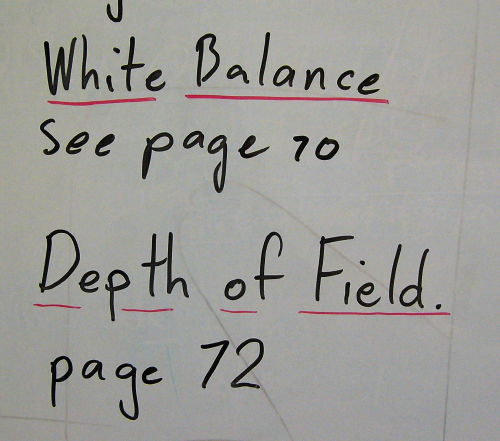
In optics, particularly as it relates to film and photography, the depth of field (DOF)
is the portion of a scene that appears sharp in the image. Although a lens can precisely
focus at only one distance, the decrease in sharpness is gradual on either side of the
focused distance, so that within the DOF, the unsharpness is
imperceptible under normal viewing conditions.


Most video and digital still cameras can adjust for color temperature by zooming
into a white or neutral colored object and setting the manual "white balance"
(telling the camera that "this object is white"); the camera then shows true white
as white and adjusts all the other colors accordingly. White-balancing is necessary
especially when indoors under fluorescent lighting and when moving the camera
from one lighting situation to another. Most cameras also have an automatic white
balance function that attempts to determine the color of the light and correct accordingly.
While these settings were once unreliable, they are much improved in today's digital
cameras, and will produce the "correct" white balance in a wide variety
of lighting situations.

P1080045.jpg
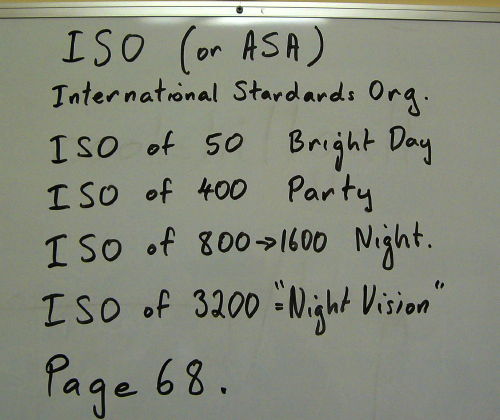
ISO setting or Film speed is the measure of a photographic film's sensitivity to light,
determined
by sensitometry and measured on various numerical scales, the most
recent being
the ISO system. Relatively insensitive film, with a correspondingly
lower speed
index requires more exposure to light to produce the same
image density as a
more sensitive film, and is thus commonly termed a slow film.

Highly sensitive films are correspondingly termed fast films.

Grainy high speed B/W film negative


In digital camera systems, an arbitrary relationship between exposure and

sensor data values can be achieved by setting the signal gain of the sensor.

The relationship between the sensor data values and the lightness of the

finished image is also arbitrary, depending on the parameters chosen for the

interpretation of the sensor data into an image color space such as sRGB.

P1080044.jpg
See also = These notes from other Terms

Examples of metering modes Cameras generally allow the user to select between spot,
center-weighted average, or multi-zone metering modes.
Various metering modes are
provided to allow the user to select the most appropriate one for use
in a variety of lighting conditions.


P1080043.jpg
Picture no 4


P1080042.jpg
Parallax is an apparent displacement or difference of orientation of an object
viewed along two different lines of sight, and is measured by the angle or
semi-angle of inclination between those two lines.

IMG_0436.jpg


IMG_0436.jpg
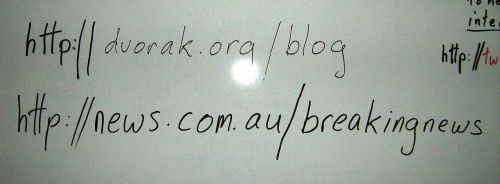
These are some of my favourite info sites http://www.yourtv.com.auand also
http://www.dvorak.org/blog/ I'll post more in the future.


IMG_0437.jpg
http://twitter.com/jimbell and also http://twitter.com/U3ADigitalPhoto

Chapter 4 and 5 of Digital Photography "Digital Camera Techniques" and

"Capturing Digital Images" are well worth the read


IMG_0438.jpg
A blog (a contraction of the term weblog) is a type of website, usually maintained

by an individual with regular entries of commentary, descriptions of events,

or other material such as graphics or video.

Entries are commonly displayed in reverse-chronological order.

"Blog" can also be used as a verb, meaning to maintain or add content to a blog.
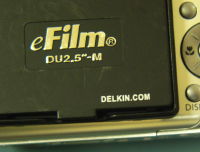

P1080040.jpg
An interesting addition for your digital camera screen.
"Pop-Up Shades are LCD screen protective covers, which also double as glare guards."

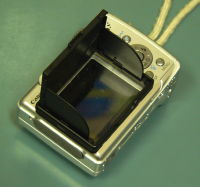
P1080038.jpg P1080036.jpg
These pop-up shade/covers are available at http://delkin.com/products/popupshades/index.html

Wednesday, August 27, 2008

Term 3 Session 4 Camera Settings, Histograms, Batteries, Gorilla Pod

(UPDATE Aug 2012 - I have removed images that won't display correctly but will leave the text here as reference)

Http://jimbell.id.au
Remember ... my site is ".id.au" not ".com.au"
for an explanation of ".com" etc try
Generic top-level domain <=== at Wikipedia


ISO Settings from Wikipedia...
"For digital photo cameras ("digital still cameras").... ISO setting—is specified by the manufacturer such that .... image files produced by the camera will have a lightness similar to what would be obtained with film of the same rating at the same exposure. The usual design is that the camera's parameters for interpreting the sensor data values ... are fixed, and a number of different ... choices are accommodated by varying the sensor's signal gain ... prior to conversion to digital."
From:   http://en.wikipedia.org/wiki/Film_speed#Exposure_index

Cameratown.com
ISO Sensitivity:

"A camera's ISO function sets the light sensitivity of the camera's image sensor (this is similar to the speed rating of FILM). ISO settings are often rated at 100, 200, or 400 but go as high as 800, 1600, and even 3200 on some advanced models. A lower ISO setting is used when capturing overly bright scenes, since it reduces the light sensitivy of the image sensor. This is ideal when shooting at the beach, on a ski slope, or under the midday sun. A higher ISO settings is often used when shooting under dimmer conditions (cloudy days, indoors, etc.) since it increases the light sensitivity of the image sensor. As brightness in a scene is decreased the camera tries to compensate by slowing the shutter speed which in turn lets in more light but increases the risk of motion blur. To prevent this, you can increase the ISO or sensitivity of the camera, which allows the camera to select a higher shutter speed, thus reducing motion blur. "
From:   http://www.cameratown.com/guides/iso.cfm   <<=== Follow this link
For a good explanation of ISO and how to use it.

"White Balance is an aspect of photography that many digital camera owners don’t understand or use - but it’s something well worth learning about as it can have a real impact upon the shots you take.
So for those of you who have been avoiding White Balance - let me introduce you to it. I promise to keep it as simple as possible and keep what follows as useable as I can:
At its simplest - the reason we adjust white balance is to get the colors in your images as accurate as possible."
From:  http://digital-photography-school.com/blog/introduction-to-white-balance/
White-Balance

"What is a Histogram

Histograms are a topic that we could (and probably should) spend a lot of time talking about but let me give you a very brief answer to get you through in the short term.

Histograms are a very useful tool that many cameras offer their users to help them get a quick summary of the tonal range present in any given image.
It graphs the tones in your image from black (on the left) to white (on the right).
The higher the graph at any given point the more pixels of that tone that are present in an image.
So a histogram with lots of dark pixels will be skewed to the left and one with lots of lighter tones will be skewed to the right.
The beauty of a histogram is that the small LCD display on your camera is not really big enough to give you an great review of a picture and you can often get home to find that you’ve over or under exposed an image. Checking the histogram can tell you this while you’re in a position to be able to adjust your settings and take another shot."


A nickel-metal hydride battery, abbreviated NiMH, is a type of rechargeable battery similar to a nickel-cadmium (NiCd) battery but using a hydrogen-absorbing alloy for the negative electrode instead of cadmium.
As in NiCd batteries, the positive electrode is nickel oxyhydroxide
(NiOOH). A NiMH battery can have two to three times the capacity of an
equivalent size NiCd. However, compared to the lithium-ion battery, the volumetric energy density is lower and self-discharge is higher.
Lithium-ion batteries (sometimes abbreviated Li-ion batteries) are a type of rechargeable battery in which a lithium ion moves between the anode and cathode. The lithium ion moves from the anode to the cathode during discharge and from the cathode to the anode when charging.

Lithium ion batteries are commonly used in consumer electronics. They are currently one of the most popular types of battery for portable electronics, with one of the best energy-to-weight ratios, no memory effect, and a slow loss of charge
when not in use. In addition to uses for consumer electronics,
lithium-ion batteries are growing in popularity for defense,
automotive, and aerospace applications due to their high energy
density. However certain kinds of mistreatment may cause Li-ion
batteries to explode.
From: http://en.wikipedia.org/wiki/Lithium-ion_battery


(NB.I still need to do more research so I can write up about focusing.)


The Original Gorillapod
is ideal for point-and-shoot compact
digital cameras weighing up to 9.7oz (275g).

http://www.joby.com/
"The Original Gorillapod is the lightest and most versatile camera tripod available today. Featuring over two dozen flexible leg joints that bend and rotate, the Gorillapod will firmly secure your compact digital camera to virtually any surface — anywhere and everywhere!"
http://www.joby.com/products/gorillapod/original/